Ask ten people what a stream pays and you will get ten different numbers, most of them wrong.
The confusion is understandable, because the honest answer is that no platform pays a fixed rate per stream. Not one of them. What you actually earn depends on where your listener lives, whether they pay for a subscription, what deal your distributor is on, and what everyone else on the platform was streaming that month.
That said, "it depends" is a useless answer when you are trying to work out whether a release is worth funding. So here are the real numbers, what sits behind them, and what an Australian artist actually banks.
Figures below are in USD unless stated, because that is how the platforms report. At the time of writing one Australian dollar buys roughly 70 US cents, so multiply USD figures by about 1.4 for a rough AUD equivalent.
The short answer
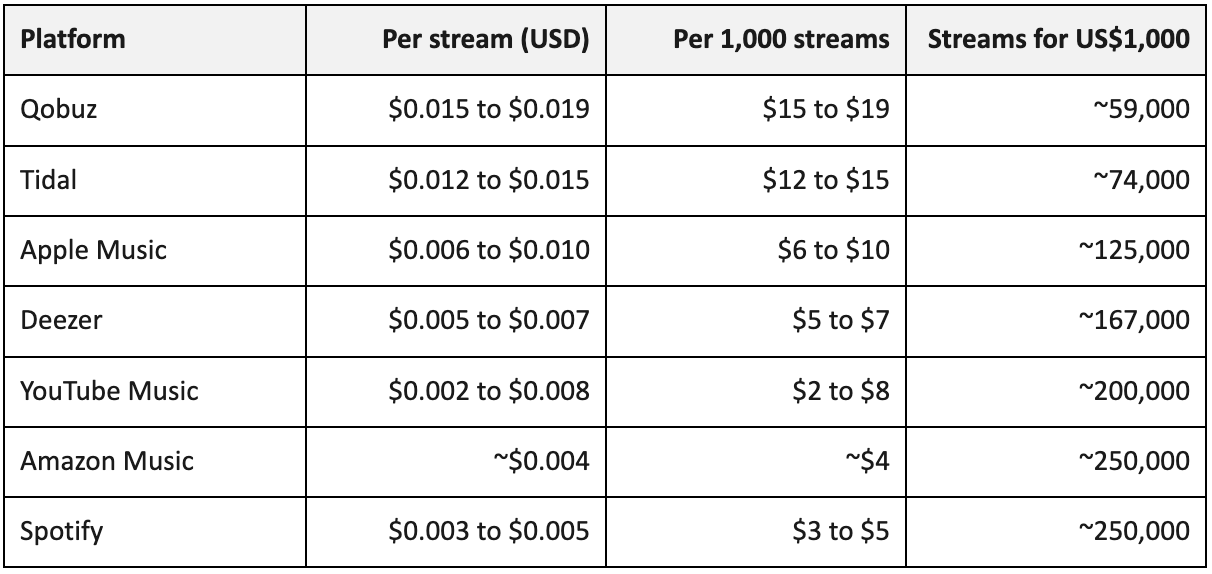
Two things jump out of that table, and both are traps.
The first trap is thinking Spotify is ripping you off because it sits near the bottom. The second is thinking you should chase Qobuz because it sits at the top. Neither conclusion survives contact with reality, and we will get to why.
Why there is no fixed rate
Almost every platform on that list uses the same basic model, called pro rata.
The platform collects all its money for the month, from subscriptions and from advertising. It keeps roughly 30% to cover its costs. The remaining 70% goes into a pool. Your share of that pool is your share of total streams on the platform that month.
So if your tracks accounted for 0.001% of everything streamed on Spotify in July, you get 0.001% of July's pool.
This has three consequences worth understanding.
Your rate moves month to month. When a platform adds subscribers or ad revenue spikes, as it does every December, the pool grows and everyone's effective rate ticks up. Quiet months pull it back down.
Your rate is affected by everyone else. If total streams across the platform grow faster than revenue, the same number of streams earns you less. You have no control over this.
The published "rate" is arithmetic after the fact. Nobody sets it. It is total payout divided by total streams, worked out backwards once the money has moved. Treat any per-stream figure, including the ones in this article, as a planning benchmark rather than a promise.
Spotify: $0.003 to $0.005
Spotify pays between $0.003 and $0.005 per stream, with most independent artists landing near $0.004. That is roughly $4 per 1,000 streams, or about 250,000 streams to clear US$1,000 before anyone takes a cut.
In Australian terms, a million Spotify streams is somewhere around AU$5,700 gross.
Spotify sits at the low end of the table for one structural reason: it has a huge free tier. Spotify reported 751 million monthly users and 290 million paying subscribers, which means well over half its audience is generating ad revenue rather than subscription revenue. Ad-supported streams pay a fraction of what premium streams pay, and that drags the blended average down for everyone.
The counterweight is scale. Spotify paid the music industry more than $11 billion in 2025, taking its lifetime payouts to nearly $70 billion, and payouts grew more than 10% year on year while other industry income sources grew closer to 4%. For most independent artists, Spotify is still the single biggest line on the royalty statement, low rate and all.
The 1,000-stream threshold
This is the Spotify policy that catches people out, and it is the one you need to know.
Since April 2024, a track must reach 1,000 streams in a rolling 12-month period before it generates any royalties at all. Under that threshold, it earns nothing. The policy is reported to have demonetised the large majority of tracks on the platform.
For an artist with a deep catalogue, this matters. Those album tracks quietly pulling 200 streams a year are not paying you anything. They still count toward your artist profile and your algorithmic footprint, but they are not money.
Apple Music: $0.006 to $0.010
Apple Music pays roughly double what Spotify pays, in the region of $0.006 to $0.010 per stream, or about $6 to $10 per 1,000. You need around 125,000 streams to clear US$1,000.
The reason is simple and worth internalising because it explains the whole table: Apple Music has no free tier. Every single stream comes from someone paying a monthly subscription. There is no ad-supported revenue diluting the pool.
This is why the Apple line on your royalty statement is often disproportionately large relative to the stream count. If 20% of your streams come from Apple but 35% of your revenue does, that is not an error. That is the subscription-only model doing its job.
One practical note: Apple reports to distributors on a two to three month lag, so the streams you are seeing today will not appear as money for a while.
YouTube: it is not one number
YouTube is where most articles on this topic get lazy, quoting a single figure that is basically meaningless. YouTube is not one revenue stream. It is at least three, and they pay very differently.
YouTube Music (premium subscribers). Roughly $0.005 to $0.008 per stream. Comparable to the lower end of Apple.
YouTube Music and video (ad-supported). Roughly $0.001 to $0.003 per stream, driven entirely by advertising rates in the listener's country and the ad demand around the video.
Content ID. When someone else uses your music in their video, Content ID identifies it and pays you a share of that video's ad revenue. Rates here are low per play, around $0.0008 to $0.002, but the volume can be enormous.
Blend all of that together and you land at an average somewhere around $0.007, which is the figure you will see quoted most often. It is a true average and a fairly useless one, because your actual YouTube income depends entirely on which of those three buckets your plays fall into.
Here is the part worth acting on: Content ID is the most commonly uncollected revenue in independent music. If your distributor does not deliver your recordings to Content ID, every fan edit, gym reel, gaming video and TikTok repost using your song is generating advertising revenue that goes to somebody who is not you. Check that this is switched on. It costs nothing and it is pure recovered income.
What actually moves your rate
The platform logo matters far less than four other things.
1. Where your listeners live
This is the biggest lever most artists never think about. Every country has its own revenue pool, priced off local subscription costs.
A stream from a US listener is worth somewhere around $0.0046. A UK stream, about $0.0044. A stream from Brazil might be worth $0.0012. A premium stream from Norway can reach $0.0068, while an ad-supported stream from India might be worth $0.0008. That is an eightfold spread on the same platform for the same song.
Good news for Australian artists: Australia is a high-paying market. Subscription prices here are among the higher tier globally, so a domestic listener base is worth more per head than the global blended averages suggest. Your first thousand local fans are worth more than a thousand fans in a low-priced market.
The strategic version of this: 50,000 streams from a market that pays well will outperform 100,000 streams from one that does not. When you are choosing where to put ad spend or which markets to service with a tour, the payout map is a legitimate input.
2. Free versus premium
Premium streams pay roughly two and a half to three times what ad-supported streams pay. You cannot control which tier your listeners are on, but it explains a lot of variance between two artists with identical stream counts.
3. Your distributor's cut
This one you fully control, and it is the difference between keeping your money and not.
Everything a platform pays goes to your distributor first. What lands in your account is whatever is left after their cut. Some distributors take 9%. Some take 15% to 20%. A major label deal might leave the artist with 15% of the total.
Run the numbers on a million Spotify streams at $0.004, which is US$4,000 gross:
- A distributor keeping 0% leaves you US$4,000
- A distributor keeping 9% leaves you US$3,640
- A distributor keeping 20% leaves you US$3,200
- A traditional label deal at 15% to the artist leaves you US$600
Same song. Same streams. Same platform. Nearly a seven-fold difference in what you actually bank. This is why we pay out 92% and say so on the front page. Over a career, the split is a bigger financial decision than the platform mix will ever be.
4. Real streams versus bought ones
Artificial streams from paid placement services do not just fail to pay. Platforms detect and strip them, and repeated offences can get a release penalised or pulled. There is no version of this that works.
The bit most articles leave out: this is only half your money
Everything above concerns your recording royalties, the money paid for the use of the sound recording. If you are self-releasing, that is the money that flows through your distributor.
If you wrote the song, there is a second stream entirely.
Publishing royalties are paid for the composition, the underlying song rather than the recording. These do not come through your distributor. They come through APRA AMCOS, and you only get them if you are a member and your works are registered with correct splits. Spotify has said that 2025 was its largest publishing payout ever, with around $5 billion paid to publishers and songwriter organisations over two years. That money exists whether or not you have claimed your share.
Neighbouring rights are a third stream, covering broadcast and public performance of the recording. In Australia this is PPCA territory. Radio play, music in venues, music in shops. Again, not your distributor.
An Australian artist who is distributing but not registered with APRA AMCOS is leaving a meaningful percentage of their total income uncollected. Not a rounding error. A percentage.
What this looks like as a real budget
Say you release a single and it does 100,000 streams across platforms in its first year. A typical independent split might be 60% Spotify, 15% Apple, 15% YouTube, 10% everything else.
- 60,000 Spotify streams at $0.004 = US$240
- 15,000 Apple streams at $0.008 = US$120
- 15,000 YouTube streams at $0.004 blended = US$60
- 10,000 other streams at $0.006 = US$60
Total: roughly US$480, or around AU$680 gross.
Through a distributor keeping 20%, that becomes about AU$545. Through G.Y.R.O. at 92% to the artist, about AU$625. Add publishing through APRA AMCOS if you wrote it, which might add another 15% to 20% on top of the recording side.
That is the real shape of it. Streaming at independent scale is rarely the main event on its own. It is one line in a stack that also includes live, merch, sync and publishing. The artists who make it work treat it as infrastructure rather than as the plan.
The encouraging part
It is easy to read all of this and conclude the numbers are hopeless. The data says otherwise, and specifically it says the independent path is working better than it used to.
Roughly half of Spotify's royalties in 2025 went to independent artists and labels. More than 13,800 artists generated at least $100,000 from Spotify alone, up nearly 1,400 on the year before, and 85% of the new six-figure earners were based outside the United States. The 100,000th highest-earning artist on the platform made more than $7,300 in 2025. Ten years earlier, that same position earned $350.
More than a third of artists earning $10,000 or more were DIY or started out DIY. Among artists who debuted in the last decade, more than half of all royalties were generated by artists who self-released or began by self-releasing. Over 90% of DIY royalties went to artists who had been releasing since before 2024, which is to say working musicians building catalogues, not one-off viral spikes.
The gap between a hobby and a living is not usually a better per-stream rate. It is catalogue depth, a listener base in markets that pay, a distribution deal that does not skim, and every royalty stream actually claimed.
Frequently asked questions
How much does Spotify pay per stream in Australia?
Spotify does not publish country-level rates, but Australia is a comparatively high-paying market because local subscription prices sit in the upper global tier. Australian listeners generally generate more per stream than the $0.003 to $0.005 global blended average, particularly on premium accounts.
How many streams do you need to earn $1,000?
Roughly 250,000 on Spotify, around 125,000 on Apple Music, and somewhere between 125,000 and 500,000 on YouTube depending on the mix of premium, ad-supported and Content ID plays. Those are gross figures before your distributor's cut.
Does Spotify pay more than Apple Music?
Per stream, no. Apple Music typically pays around double. In total, Spotify usually pays most independent artists more, because it delivers far more streams. Rate and revenue are different questions.
Why did my per-stream rate drop this month?
Almost always the pool. If platform-wide streams grew faster than platform revenue, the same number of streams earns less. Rates also fall after December, when holiday advertising revenue drops out. A shift in where your listeners are coming from can do it too.
Do I get paid for streams under 1,000?
Not on Spotify. Since 2024, a track needs 1,000 streams in a rolling 12 months before it earns anything. Apple Music, Amazon and Tidal have not adopted the same threshold.
Is Content ID worth setting up?
Yes, and it is the most commonly missed income in independent music. If your music appears in other people's videos at any volume, Content ID revenue can rival your YouTube Music royalties.
Getting the most out of what you earn
You cannot set the per-stream rate. You can control three things that matter more:
Keep more of what you make. The distributor cut is the largest single variable in this entire article and the only one that is a straight choice.
Collect everything you are owed. Distribution covers recording royalties. APRA AMCOS covers publishing. PPCA covers neighbouring rights. Content ID covers user-generated video. Four systems, four registrations, and most artists are only signed up to one.
Build in markets that pay. Where your listeners are is worth as much as how many of them there are.
G.Y.R.O. pays out 92% of royalties, delivers to every major platform including Content ID, and is Independently owned with support in your timezone. If you are on a service taking a fifth of your income, the maths above is the whole argument.
Thanks for reading and don't forget to go get your record out . 🎶
!%20(8).png)

